Repair business profit is what remains after subtracting every direct and indirect cost of running your shop from total revenue, not just the cash that lands in your register each day. Many shop owners watch daily sales and assume busy means profitable, but a repair that generates revenue can still lose money once parts, technician time, and a share of fixed overhead are accounted for. Understanding repair business profit starts with separating gross profit, the amount left after the direct cost of one job, from net profit, what remains after fixed overhead is paid across your entire operation. This guide walks through the formulas, hypothetical arithmetic, and daily workflow habits that let you see whether a repair actually made money, and how deposits, refunds, and overhead change that answer.
Gross Profit vs Net Profit in a Repair Shop
Gross profit answers a narrow question: did this specific job cover its direct costs? The formula is:
Gross Profit = Revenue from the repair − Cost of Goods Sold (COGS)
COGS for a repair ticket typically includes the part itself, any shipping or consumable fee, and the portion of technician wages tied directly to bench time on that job. It does not include rent, insurance, or your software subscriptions.
Net profit answers a wider question: did the shop as a whole make money this month? The formula is:
Net Profit = Total Gross Profit (all jobs) − Fixed Overhead
Fixed overhead includes rent, utilities, administrative salaries, marketing, and recurring software costs you pay whether you complete five repairs or fifty. A shop can have a healthy gross margin on every ticket and still post a net loss if overhead is too high relative to repair volume.
As a hypothetical illustration, suppose a shop completes 40 repairs in a month with an average gross profit of $70 per job. That is $2,800 in total gross profit. If fixed overhead for the month is $3,200, the shop has a net loss of $400 despite every individual repair appearing profitable on paper.
Calculating Labor and Parts Costs Per Repair
Breaking a repair into its components shows exactly where the money goes. Using a hypothetical screen replacement priced at $150:
- Customer payment: $150
- Parts cost (screen assembly): −$45
- Technician labor allocated to this job: −$25
- Gross profit: $80
- Gross margin: 53%
Compare that to a hypothetical battery replacement priced at $60:
- Customer payment: $60
- Parts cost: −$15
- Technician labor allocated: −$10
- Gross profit: $35
- Gross margin: 58%
Even though the battery job generates less revenue, its gross margin percentage is higher. Tracking labor and parts separately, rather than lumping them into one undifferentiated repair cost, lets you see whether pricing on faster, lower-cost repairs is actually more efficient than pricing on complex ones. A shop that records technician time only as shop-open hours instead of actual bench minutes per ticket will not see this difference, which is one reason consistent use of repair ticket software, tracked from intake through technician assignment to final payment, makes these calculations possible rather than approximate.
Overhead, Break-Even, and Monthly Net Profit
Once you know your average gross profit per job, you can calculate how many repairs you need to cover fixed overhead before any repair contributes to net profit.
Hypothetical example: a shop's fixed monthly costs are $4,500 (rent, utilities, software, one administrative wage). Average gross profit per repair across all ticket types is $70.
Break-even repairs = $4,500 ÷ $70 ≈ 65 repairs per month
Every repair beyond the 65th contributes its full gross profit directly to net profit. If the shop completes 90 repairs that month, the 25 additional jobs beyond break-even generate roughly 25 × $70 = $1,750 in net profit for the period.
This calculation also shows why inefficiency is costly. If average technician time per job increases because parts are hard to locate or diagnostics take longer than scheduled, the direct labor cost per job rises and gross profit per job falls, which pushes the break-even point higher without changing rent or utilities. Shops that monitor repair shop inventory closely, so technicians are not searching shelves for a part that should already be staged, keep labor cost closer to the estimate used when the job was priced.
Deposits and Refunds: Protecting Your Margin
Deposits and refunds affect cash flow and profit differently, and treating them the same way in your books can hide real losses.
Hypothetical deposit scenario: a customer pays a $30 deposit on a mail-in repair requiring a special-order part that costs the shop $40 up front. If the customer later cancels before the part ships, and the shop refunds the full $30 deposit, the shop has already committed $40 to the part and recovers nothing from the customer, for a net loss of $40 on that ticket plus the labor time spent processing the order. A non-refundable or partially refundable deposit policy on special-order parts is one way shops avoid converting a cancelled repair into a guaranteed loss, though whether and how much to charge depends on supplier terms and local consumer-protection rules in each shop's jurisdiction.
Hypothetical refund scenario: a shop completes a $150 screen repair and the customer returns the next day with a new crack from an unrelated drop. If the shop performs a second repair under goodwill rather than charging again, it pays for a second part (−$45) and additional labor (−$25) with no new revenue, which fully erases the $80 gross profit originally earned on that ticket and pushes that specific job into a net loss unless a separate charge is applied for the new damage.
Recording the IMEI or serial number of the device at intake and at every subsequent repair event protects a shop from exactly this ambiguity, because it creates a record distinguishing a genuine warranty comeback from a new, unrelated, billable repair. IMEI tracking software makes that history searchable instead of relying on memory or a paper ticket stack.
Turning These Numbers Into Shop Decisions
Monthly profit calculations are only useful if the underlying ticket data is accurate. That means recording actual parts used per ticket so they are deducted from inventory at the correct cost, assigning technician time to the specific job rather than the shift, and logging every deposit and refund against the ticket it belongs to rather than as a general cash adjustment.
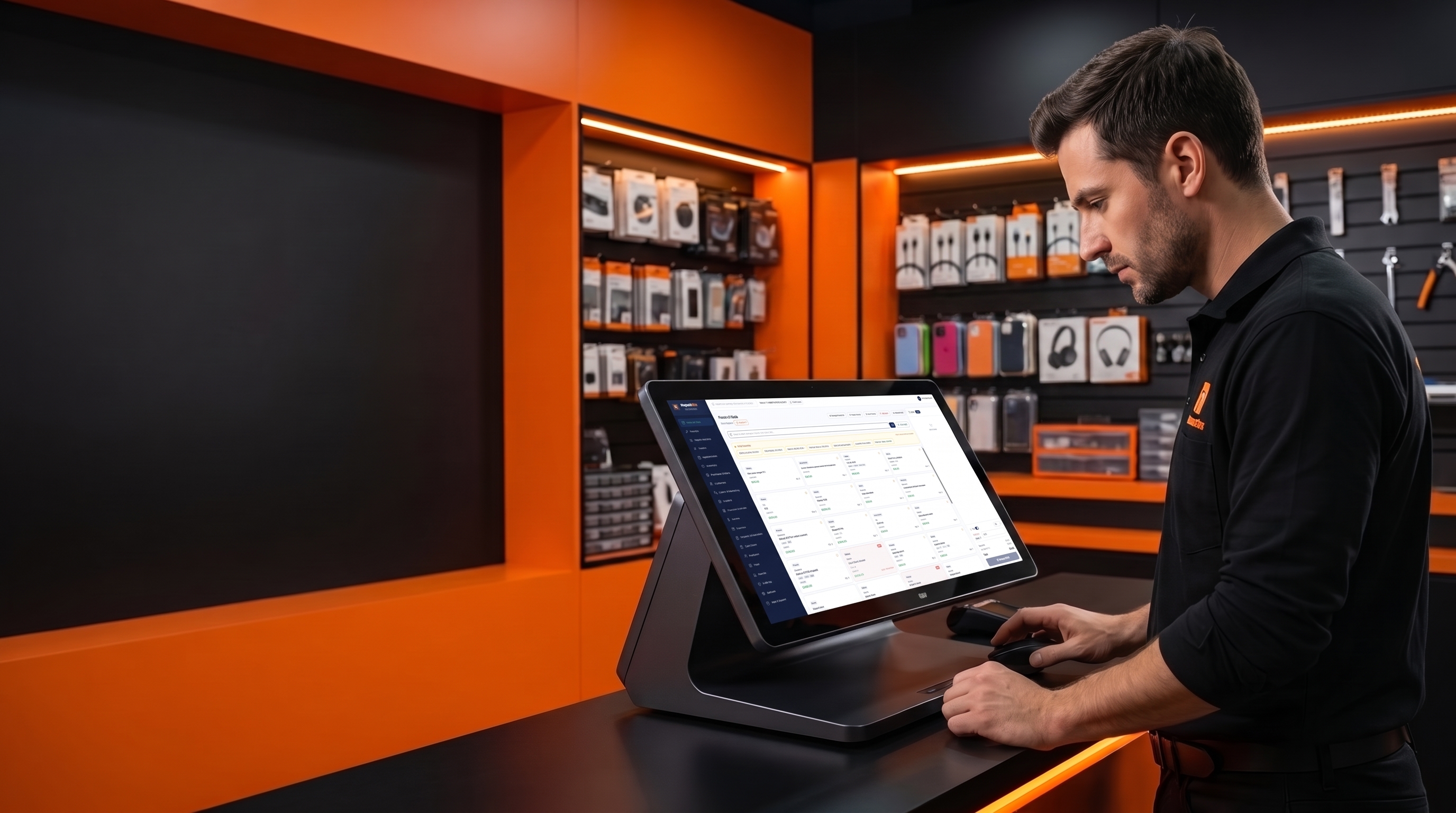
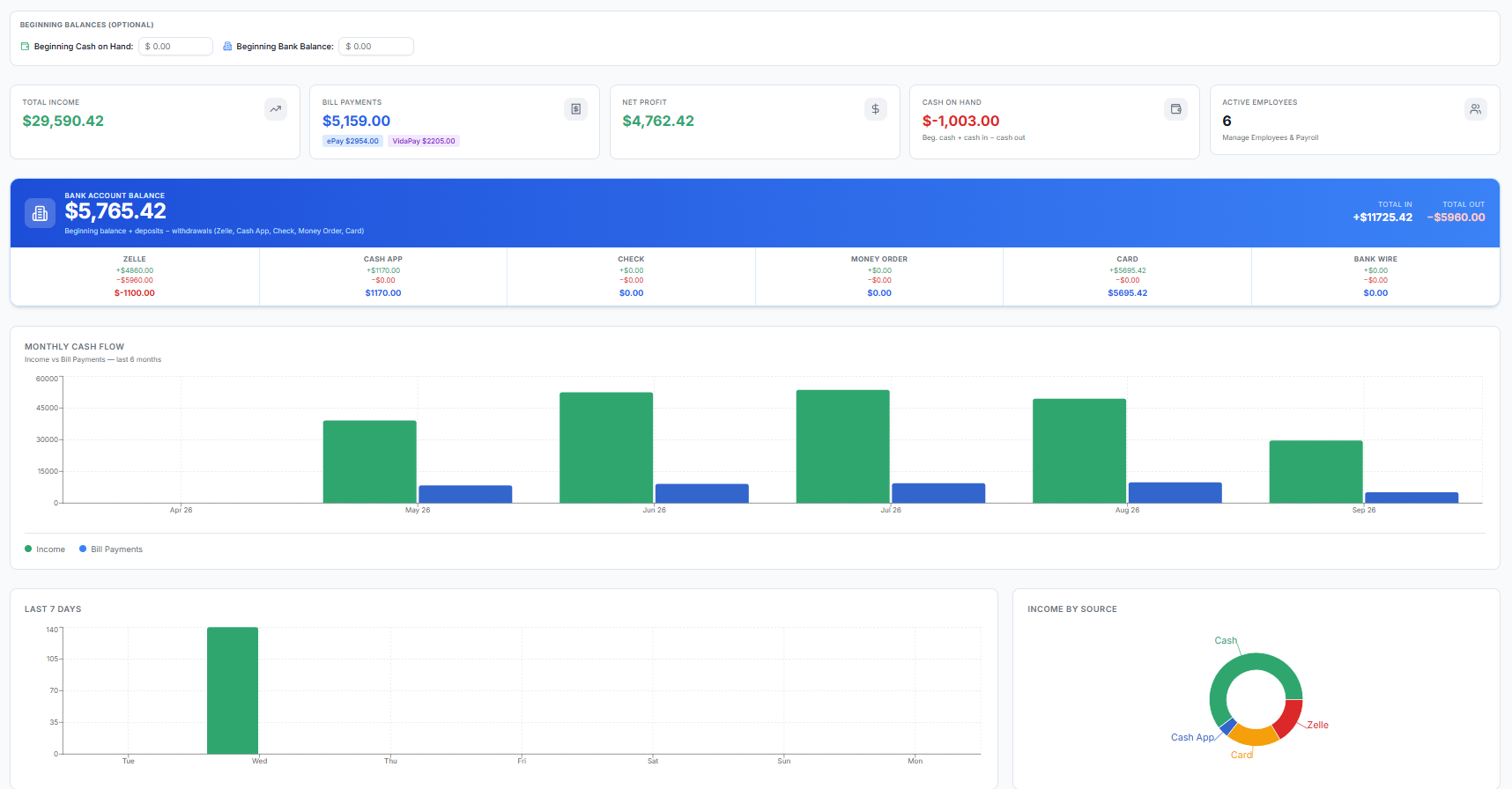
A shop's financial overview, drawn from point-of-sale and accounting records together, is where gross profit by repair type and net profit by month should be visible without manual spreadsheet reconciliation. Reviewing repair shop POS data for average ticket price alongside repair shop accounting software for overhead and expense tracking lets an owner see, in one place, whether a slipping average ticket price or a rising parts cost is the real cause of a disappointing month, rather than guessing from the till at closing time.
Frequently asked questions
What is the difference between gross profit and net profit for a repair shop?
Gross profit is the revenue from a single repair minus the direct cost of that job, such as the part and the technician's bench time. Net profit is what remains after you also subtract fixed overhead, such as rent, utilities, and software, from your total gross profit across all repairs in a given period.
How many repairs does my shop need to complete to break even each month?
Divide your total fixed monthly costs by your average gross profit per repair. For example, $4,500 in fixed costs divided by $70 average gross profit per job means you need roughly 65 repairs that month before any additional repair contributes to net profit.
How should I handle a refund on a failed repair without erasing my margin?
A goodwill repeat repair with a new part and additional labor but no new revenue typically erases the original gross profit on that ticket. Many shops reserve free comebacks for the same confirmed issue and charge separately for unrelated new damage, which keeps warranty costs predictable rather than open-ended.
How do deposits on special-order parts affect profit if a customer cancels?
If you have already paid for the part before the customer cancels and you refund the full deposit, you absorb the part cost as a loss. A partially refundable or non-refundable deposit policy on special-order items can offset that risk, depending on your supplier terms and local rules.
Why track parts cost and labor cost separately instead of one combined repair cost figure?
Separating the two shows where your margin is actually coming from. A repair with a low parts cost but long labor time may have a lower true margin than it appears, while a quick, low-priced repair with efficient labor can be more profitable per hour than a complex one.
Ready to grow your repair shop?
Manage repairs, POS, inventory and invoicing in one place. Free to try — no credit card required.
Start Your Free Trial